
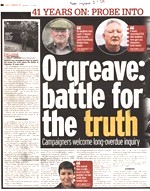
Securing full access to police plans to manage the presence of the news media at the Battle of Orgreave should be one of the priorities for the long promised Orgreave Inquiry to be chaired by the Bishop of Sheffield, Dr Pete Wilcox.
Terms of reference published in March acknowledged that the “public narrative” which developed around the most violent event during the 1984-85 miners’ strike needed to be investigated and explained.
An enduring complaint of those who took part – especially those who were injured or arrested – was their shock at the distorted and inaccurate news reporting of the way the police responded.
At issue is the degree to which pre-planned action by the police might have influenced or even shaped the news coverage.
Was there the duplicity between the Police and the media which supporters of the Orgreave Truth and Justice Campaign claim?
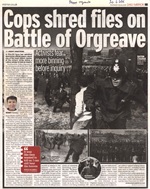
Post Orgreave research by journalists and academics, backed up by numerous broadcast interviews, has suggested that there was pre planning for media access and a determination to publicise the effectiveness of the police response.
Embedded in the mindset of police hierarchy was that there would be no repeat at Orgreave of the much-publicised humiliation at the 1972 Battle of Saltley Gate when television footage showed the police having to retreat in the face of mass picketing at the coke depot and having to ask Arthur Scargill to call on the pickets to go home.
Mrs Thatcher was herself on record as having said there would be no repeat of Saltley during the 1984-85 dispute.
As Scargill had made clear it was his intention to organise a mass picket that would be as effective as at Saltley, the police were equally determined to prevent that occurring and to demonstrate this to the public for all to see.

When arriving at Orgreave, tv crews and press photographers were directed for their own safety to agreed positions.
Effectively they were being corralled behind police lines – an advantageous position but limited to a one-sided view of the action.
Was there a pre-planned arrangement to invite tv crews and photographers to witness events from the perspective of the police?
Did this attention to detail have the desired effect and weight news coverage in their favour?
An evident imbalance in the BBC’s teatime news bulletin has become a cause celebre among those seeking the truth behind the events at Orgreave.
There was a recognition within the BBC that its report in the early evening news needed to be corrected for the later bulletin.
Next day at a BBC News and Current Affairs meeting, editor Peter Woon acknowledged that there had been “a general feeling” in the newsroom that the teatime coverage had displayed “a marginal imbalance”.
Alan Protheroe, assistant director general, admitted the report “might not have been wholly impartial”.
Complaints about the coverage were made by the NUM and the then Labour MP Tony Benn.
They argued that the BBC had screened the events in the wrong order creating the impression that mounted police charged pickets only after coming under violent attack whereas it was the police who had upped the ante and moved in first.
Replying to the criticism, Woon emphasised the pressure facing BBC journalists:
“It was exceedingly difficult to edit an hour’s shooting. Any departure from balance, however, was not such as to justify the NUM’s view that the BBC was biased.”
Perhaps, unwittingly, the minutes of the BBC editorial meeting give a clue as to why tv crews and press photographers were compliant when being shepherded to their agreed positions.
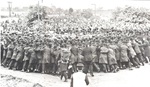
Editors pointed out that tv crews feared that if they left the relative safety of filming from agreed positions, they faced the risk of being attacked by strikers if they ventured too far behind the picket lines.
Whatever the misgiving that might have surfaced within the BBC, the tv news reports from Orgreave confirmed the view of Prime Minister Margaret Thatcher that the police were in the right.
This was, she famously said, “mob rule” by the miners which had been plain for all to see.
Cabinet records covering the period of the strike revealed the close relationship which had developed between Mrs Thatcher and officers of the South Yorkshire Police who were in the lead that day.
Another line of inquiry might well be to secure transcripts of news conferences and interviews given by senior officers in the immediate aftermath of Orgreave.
To what degree did statements by the police contribute to the narrative which attracted widespread complaints from within the mining communities and which the Orgreave Inquiry has promised to investigate?